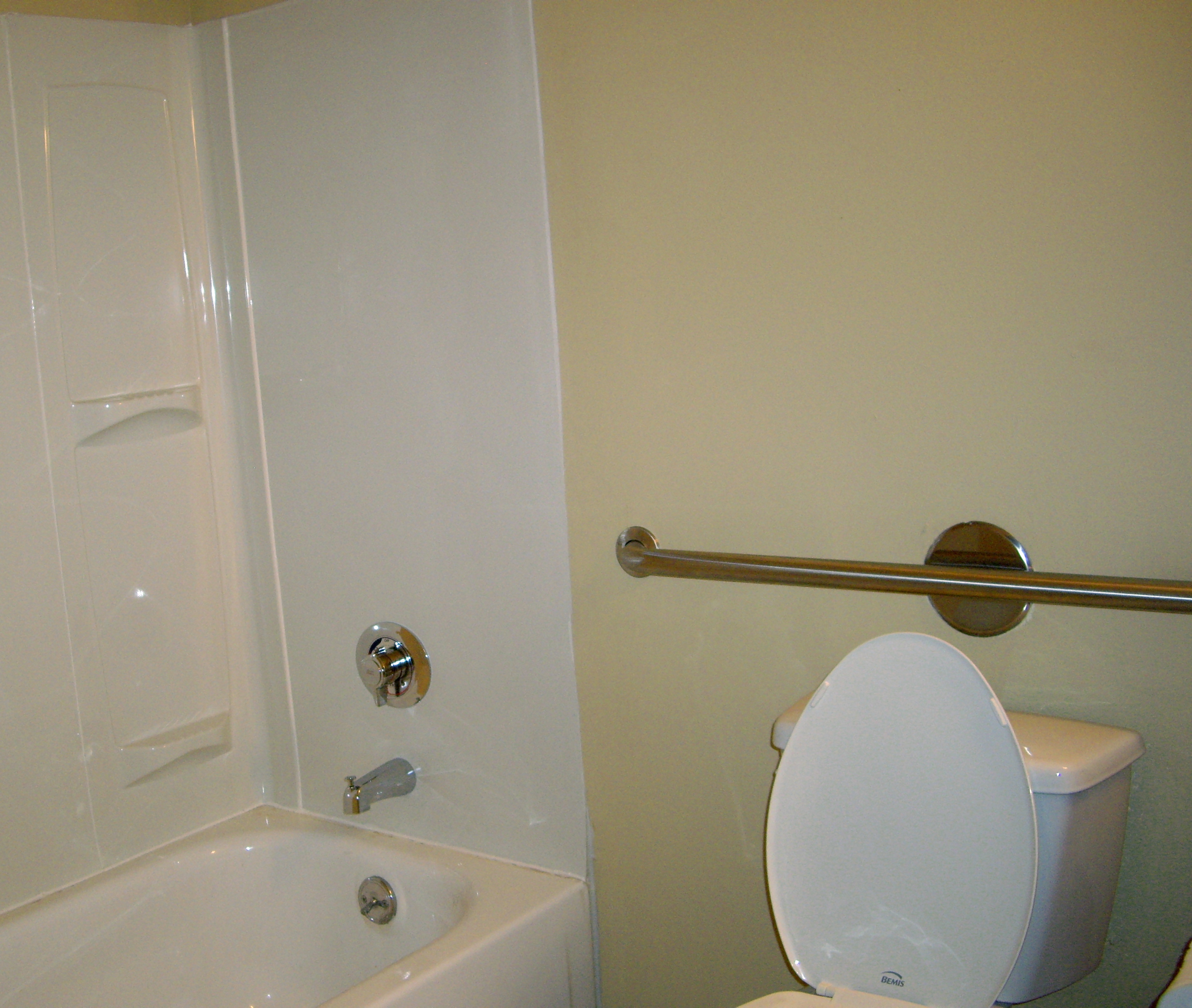
Why Grab Rail Placement Matters More Than the Rail Itself
The stainless-steel rail itself costs relatively little. The critical variable is where it goes and whether the wall behind it can take the load. In Singapore's older HDB flats — particularly those built in the 1970s and 1980s — bathroom walls are frequently covered in ceramic tiles laid over a thin concrete screed. When those tiles loosen over time, as they commonly do, a grab rail anchored into them can pull free under load, which is the opposite of what it is there for.
Professional EASE assessors check for hollow tiles by tapping before specifying anchor positions. Where the wall lacks a solid backing, the options are to install a floor-to-ceiling tension pole (which avoids wall anchoring entirely) or to first retile and then install. Retiling is not covered under EASE; residents who need it face an out-of-pocket cost before the subsidised rail can go in.
Standard Dimensions for HDB Grab Bars
HDB specifies that grab bars installed under the EASE scheme must:
- Support a static load of at least 100 kg
- Be made of stainless steel or equivalent corrosion-resistant material
- Be positioned at heights appropriate to the user's seated and standing reach — typically between 700 mm and 900 mm from the floor for toilet-side rails
- Use anchor bolts or equivalent fixings that penetrate at least 50 mm into solid backing
L-shaped bars at the toilet cistern side and straight horizontal bars beside the shower area are the two most common configurations. Some occupational therapists recommend angled bars that allow a resident to push up from a seated position and then rotate, but these require precise positioning to be effective and are more expensive than standard configurations.
Stairlifts in Singapore: Limited Applicability
The vast majority of HDB units are single-level flats, which means stairlifts are not relevant to most residents. Where they do come up is in maisonette units — two-storey HDB flats common in estates from the 1980s and 1990s — and in private housing.

For maisonette residents, a stairlift is one option. The alternative — which some families prefer — is to reconfigure the ground floor of the maisonette so the older resident can live entirely on one level, avoiding the stairs altogether. This typically involves converting a ground-floor storage or utility room into a bedroom and modifying the ground-floor toilet for accessibility. Where this is feasible structurally, it avoids both the ongoing maintenance of a stairlift and the risk of a mechanical failure leaving the resident stranded.
Stairlifts are not covered under EASE or the HDB Home Improvement Programme. They fall under privately funded assistive equipment. Suppliers in Singapore include both international brands and local dealers. A standard straight-rail stairlift for a typical HDB maisonette staircase costs between SGD 5,000 and SGD 9,000 installed, with the variation driven largely by the rail length and chair specification.
The Assistive Technology Fund (ATF), administered by the Agency for Integrated Care, may partially cover stairlift costs for persons with a qualifying disability assessment. Older adults who do not have a formal disability classification must fund this privately unless they qualify through a clinical referral.
The Lift Upgrading Programme
When HDB's older residential blocks were built, lift access was not designed for every floor. Many blocks from the 1960s through the 1980s have lifts that stop only at every third or fourth floor — meaning residents may exit the lift and then need to walk up or down one to two flights of stairs to reach their flat.
The Lift Upgrading Programme (LUP) retrofits these blocks with new lifts that stop at every floor. The programme has been running since the late 1990s, and the majority of eligible blocks in mature estates have been upgraded. However, a smaller number of blocks in estates like Bukit Merah, Queenstown, Ang Mo Kio, and Toa Payoh still have units where residents exit several floors away from their home level.
How the LUP Works
Under the LUP, HDB constructs a new lift shaft attached to the exterior of the block, or in some configurations, a standalone lift tower linked by sky bridges. The works require temporary disruption to the common corridor at each floor connection point. HDB typically holds residents' meetings to explain the process before works begin.
Residents in the affected block are required to agree to the programme by a majority vote before HDB proceeds. In practice, the threshold has been consistently met in blocks where the existing lift arrangement presents significant difficulty for older or mobility-impaired residents. The resident's share of the cost is modest — typically between SGD 1,500 and SGD 3,500 per flat, payable using CPF Medisave or in instalments — with HDB and the government bearing the substantial majority of the construction cost.
Checking If Your Block Has Been Upgraded
The HDB website's estate information section lists LUP completion status by block. Alternatively, residents can check at their HDB Branch Office or call the HDB Estate Management contact centre. If a block is in the queue for LUP but works have not begun, the waiting period varies — it depends on the construction programme and the availability of contractors.

Platform Lifts for Internal Use
For split-level HDB flats — which occur in some older designs where the flat entrance sits at a half-level above or below the corridor — small platform lifts (also called vertical platform lifts or step lifts) are occasionally considered. These are compact mechanical platforms that travel a short vertical distance, typically between 300 mm and 900 mm, and are large enough to accommodate a wheelchair.
Installing one in an HDB flat requires HDB approval under the Home Renovation Works permit system, in addition to the relevant regulatory approvals for the lift mechanism itself. The cost and complexity of these installations means they are relatively rare in HDB contexts. In private housing — landed properties or larger condominium units — they are more common.
Corridor and Common Area Modifications
Beyond the interior of the flat, the common areas of HDB blocks — lifts, corridors, void decks, and linkways — fall under estate management. Modifications to these areas are HDB's responsibility, not the individual resident's. Residents who notice barriers in common areas — for example, a broken ramp surface at the void deck, or a corridor handrail that has come loose — should report these through the HDB estate reporting channels or the OneService app.
The Neighbourhood Renewal Programme (NRP) and the Home Improvement Programme (HIP) both include elements of barrier-free access improvement in the common areas of older blocks. These are estate-level works that proceed on a precinct basis, not on individual application.
External ramps, covered linkways to bus stops, and drop-off bays with shelter are also part of Singapore's broader Barrier-Free Accessibility planning, documented in the Urban Redevelopment Authority's master plan requirements for new developments and estate renewals.
Sources: HDB, Agency for Integrated Care, Building and Construction Authority